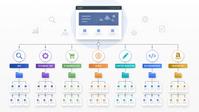
As a WordPress site grows, categories can quietly become a structural problem. New topics get added, overlapping labels accumulate, and articles that should support the same subject end up scattered across unrelated sections.
We recently cleaned up Logixscale’s category structure and organized the site around seven core SEO content pillars. The goal was not to create more taxonomy for its own sake. It was to make the site’s subjects easier to understand, easier to maintain, and easier to connect through internal linking.
Why we changed the category structure
The first issue was overlap. SEO topics can easily fit several descriptions at once: a technical SEO article may also be about crawlability, site architecture, or WordPress. If every topic becomes its own top-level category, the taxonomy becomes difficult to manage.
We wanted categories to answer a simpler question:
What major subject does this article belong to?
That led us away from treating every keyword or subtopic as a category and toward a smaller set of broad, durable pillars.
The seven core pillars
The cleaned-up structure uses seven main content pillars:
| Pillar | Primary subject | Example content |
|---|---|---|
| SEO | Core SEO strategy and organic growth | SEO strategy, planning, keyword mapping |
| Technical SEO | Crawlability, indexing, performance and site architecture | Technical audits, robots directives, Core Web Vitals |
| Ecommerce SEO | Search optimization for online stores | Category pages, product pages, ecommerce audits |
| AI SEO | Search experiences influenced by AI systems | AI search optimization and AI Overviews |
| Content Marketing | Content planning, distribution and content-led growth | Content briefs, distribution, internal content systems |
| SEO Engineering | Developer-focused SEO implementation | JavaScript, React, Next.js and technical rendering |
| Amazon | Amazon search and marketplace optimization | Keyword research and listing optimization |
These pillars are intentionally broad. Individual topics can live underneath them without requiring a new top-level category every time the editorial plan expands.
Categories are not the same as tags
One of the most useful distinctions in the cleanup was separating primary subject from specific attributes.
A category describes the main area of the site. Tags can describe narrower concepts that appear across multiple areas.
For example, an article can belong to the Technical SEO category while also using tags such as:
- SEO audit
- technical SEO
- crawlability
- indexation
- internal linking
This prevents the category system from becoming a long list of narrowly defined labels.
How the seven pillars improve site architecture
A smaller taxonomy gives the content structure a clearer hierarchy.
Logixscale
   ↓
Seven core pillars
   ↓
Topic clusters
   ↓
Individual articles
The category is the broad subject layer. Topic clusters and internal links then connect related articles within that subject.
For example, the Technical SEO pillar can contain articles about technical audits, indexing signals, robots directives, metadata, and site architecture. Those articles can then link to each other where the relationship is useful.
We did not turn every topic into a category
A common taxonomy problem is creating a new category whenever a topic appears more than once.
We avoided that approach because it can produce a flat structure such as:
SEO
Technical SEO
Crawlability
Indexation
Robots
Metadata
Internal Linking
Site Architecture
...
Many of those subjects are important, but they do not all need to be top-level categories. Making every recurring concept a category can dilute the meaning of the main navigation and make content placement inconsistent.
How we decided whether a topic deserved a pillar
We looked for subjects that could support a meaningful group of related articles rather than a single isolated post.
The practical questions were:
- Does this represent a distinct business or editorial subject?
- Can the subject support multiple useful articles?
- Will the category still make sense as the site grows?
- Does it overlap heavily with an existing pillar?
- Will readers understand the category without knowing the site’s internal taxonomy?
This keeps the structure focused on durable subjects instead of temporary editorial ideas.
How categories and internal linking work together
Categories alone do not create a strong topic architecture. The articles still need meaningful contextual links.
Our internal linking approach is therefore layered:
- Category layer: groups articles under a broad subject.
- Cluster layer: connects closely related articles.
- Contextual layer: links concepts inside the body of an article.
- Navigation layer: helps users move between related sections.
This is closely related to the internal linking work documented in Internal Linking Strategy: How to Build a Stronger SEO Site Architecture.
Examples from the current content structure
The structure becomes easier to see when existing articles are grouped by their primary subject.
Technical SEO
The Technical SEO pillar now contains audit and implementation topics such as Technical SEO Audit Checklist, WordPress SEO metadata auditing, robots directives, and server-side X-Robots-Tag investigations.
SEO
The broader SEO pillar provides a home for strategy-oriented material such as SEO Strategy: A Practical Framework for Sustainable Organic Growth.
Ecommerce SEO
The Ecommerce SEO pillar groups subjects such as ecommerce keyword mapping, category page SEO, product page SEO, and store audits.
AI SEO
The AI SEO pillar groups content about AI search and modern discovery surfaces, including AI Search Optimization and Google AI Overviews.
Content Marketing
The Content Marketing pillar covers content planning and distribution topics, including SEO Content Briefs and content distribution.
SEO Engineering
The SEO Engineering pillar is for implementation-heavy subjects such as JavaScript SEO and React/Next.js technical SEO.
Amazon
The Amazon pillar separates marketplace search topics such as Amazon keyword research and listing optimization from the site’s general SEO content.
What we kept outside the seven pillars
The cleanup also made an important distinction between a core content pillar and a supporting taxonomy item. Not every useful classification needs to become one of the seven main editorial pillars.
That gives the site room for implementation-specific or supporting sections without weakening the meaning of the core structure.
A practical WordPress category cleanup process
If you are doing a similar cleanup on a WordPress site, a useful sequence is:
- Export the current categories and post assignments.
- Group categories by actual subject rather than their existing names.
- Identify overlapping and redundant categories.
- Define a small set of durable top-level pillars.
- Map every article to its primary pillar.
- Move narrower concepts into tags or contextual topics where appropriate.
- Review category archive URLs and internal links.
- Check redirects if category URLs are changing.
- Re-test important URLs after the taxonomy changes.
Why this is an SEO architecture change, not just a WordPress cleanup
Changing categories changes more than an admin-screen label. Category archives, internal links, navigation paths, and URL structures can all be affected.
That is why taxonomy cleanup should be treated as part of the site’s broader information architecture. The objective is to create a structure that is understandable to users and maintainable as the content library grows.
The same principle appears in our broader SEO strategy framework: structure should support a repeatable system rather than a collection of isolated optimizations.
The final seven-pillar model
The cleaned-up Logixscale architecture can be summarized as:
SEO
├── Technical SEO
├── Ecommerce SEO
├── AI SEO
├── Content Marketing
├── SEO Engineering
└── Amazon
The exact article mix inside each pillar can evolve. The important part is keeping the top level stable enough that new content has an obvious home.
The main lesson
A useful WordPress category structure should organize major subjects, not reproduce every keyword or subtopic.
For Logixscale, reducing the editorial architecture to seven durable pillars gives us a cleaner foundation for topic clusters, internal linking, category archives, and future content expansion.
The workflow is straightforward:
Audit the existing taxonomy → consolidate overlapping categories → define durable pillars → map articles → strengthen internal links → verify the resulting architecture.